Signs of Ageing in a Daguerreotype
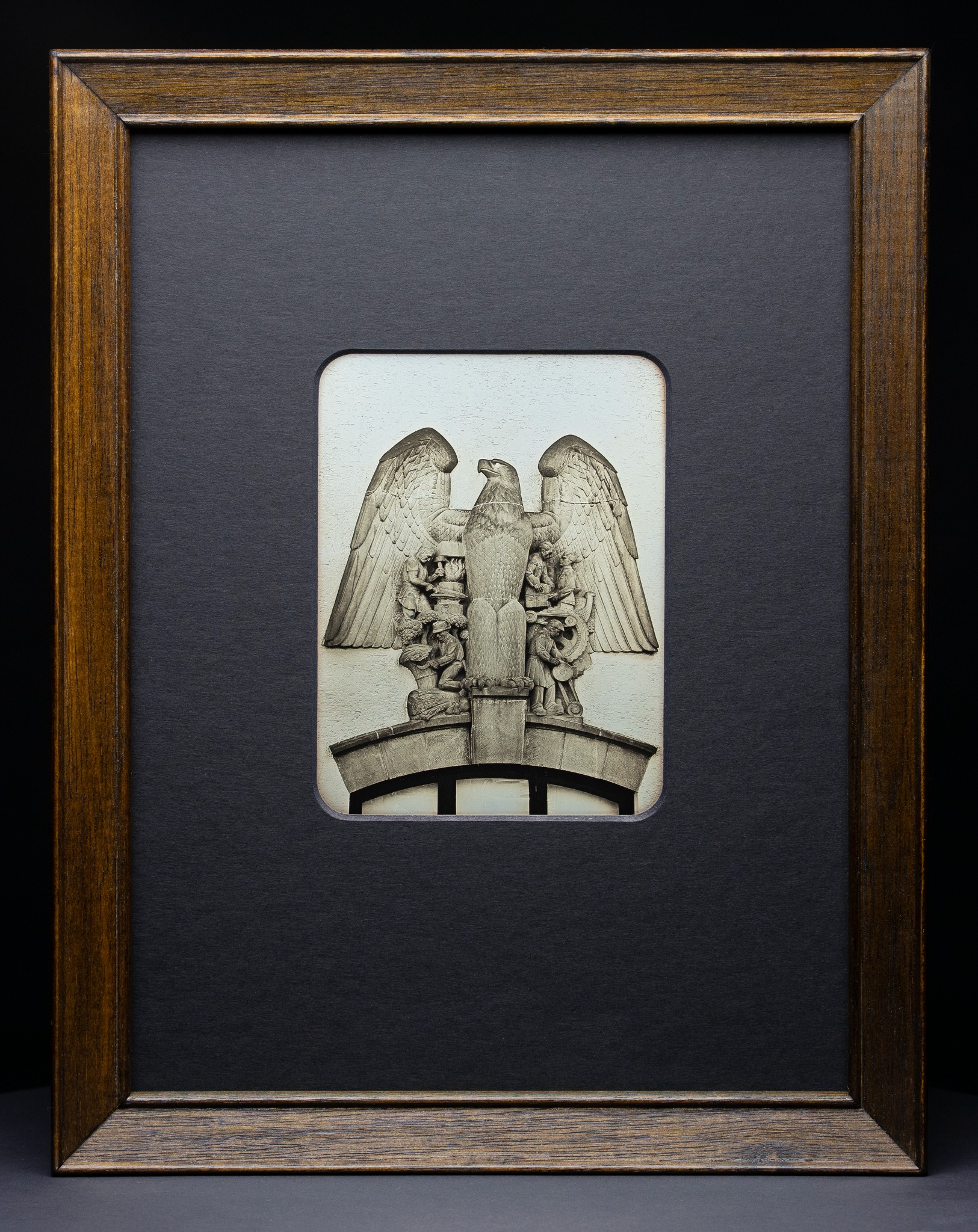
Sometimes I take another close look at my older daguerreotypes to examine their signs of ageing. After around four and a half years, the characteristic darkened edge is particularly noticeable on this plate. Otherwise, it has remained well preserved.
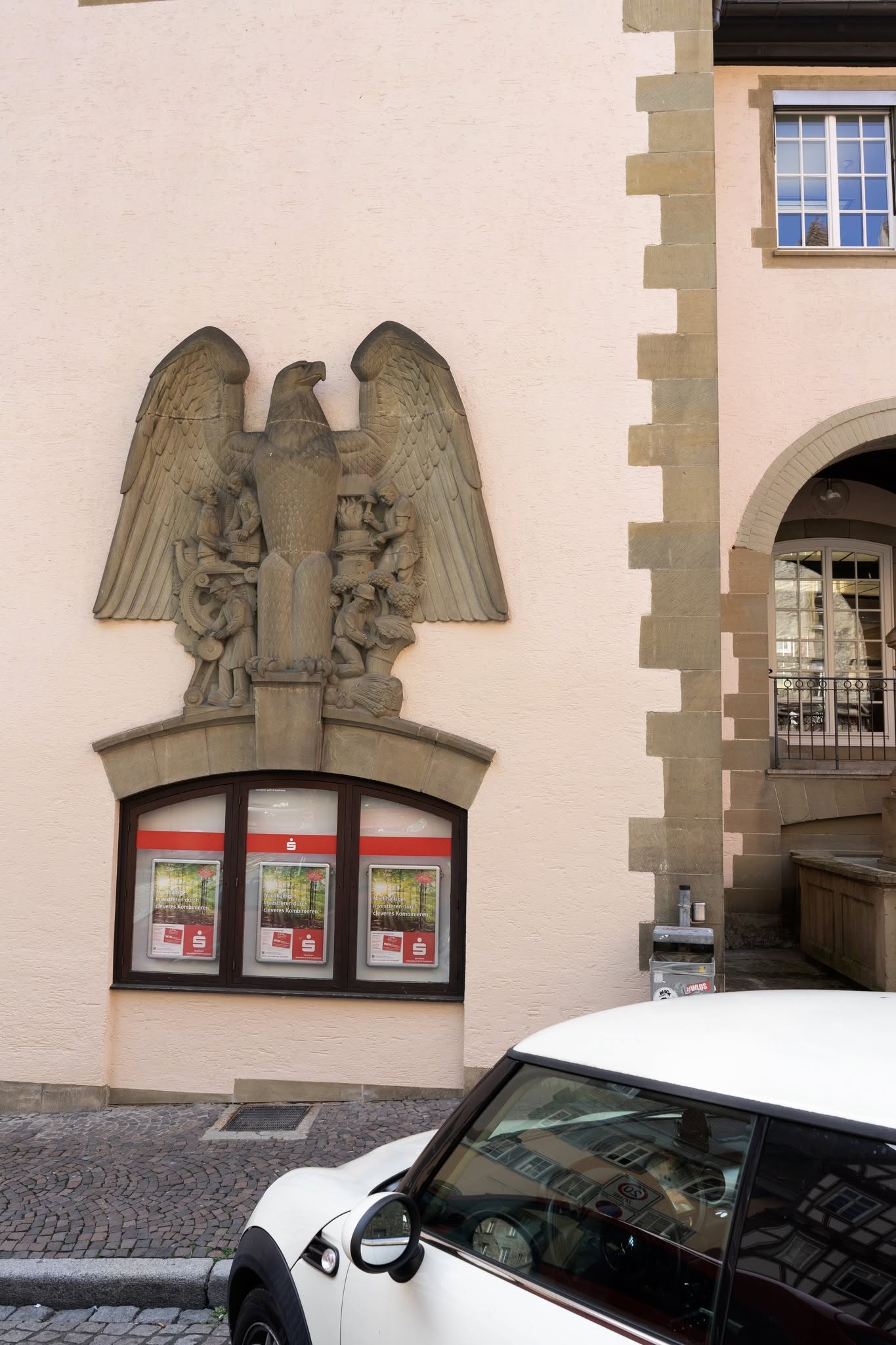
I made this daguerreotype in November 2021 in Schwäbisch Hall. It shows a wall sculpture created around 1941 by Erwin Dauner on the Sparkasse building at Hafenmarkt.
The video reveals something that is difficult to show properly in photographs: the prismatic colour effect of the daguerreotype. Even a video cannot reproduce it quite as clearly as you see it with your own eyes. But it gives you at least a sense of how even a slight change in viewing angle can shift the tones from warm to cool, sometimes almost like switching between different images.
The wall sculpture depicts a large eagle above figures representing labour, trade, industry, agriculture and crafts. Standing in front of it, this imagery is a very clear reminder of the aesthetics of the Nazi era: the state as a great protective figure over the various branches of work. Looking at it, I almost feel as though there might originally have been another symbol beneath the eagle — perhaps a swastika or another political emblem. Visually, something seems to be missing at that spot. Of course, I cannot say for certain.
Daguerreotypes age, too. Their silver surface can tarnish over time, often first becoming visible around the edges. How much a plate changes depends, among other things, on how it was made, its protective enclosure and the conditions in which it is stored. Under suitable conditions, professional conservation treatment can significantly reduce such tarnishing. Even after many years, a daguerreotype can then appear considerably clearer and fresher. Image material that has already been lost, however, cannot be recovered in this way.
I also became aware of how fragile these images are during a one-day workshop I attended with Bernd Renard in Kiel in 2015. The photographer, who has sadly since passed away, came from a long-established family of photographers and took a deep interest in daguerreotypy. He told me about an enquiry from a museum: they wanted to know whether he could make a duplicate of a badly damaged daguerreotype.
Someone had removed the plate from its enclosure and tried to “clean” its surface mechanically. According to his account, the image had been practically destroyed in the process. The extremely fine image-forming particles lie directly on the mirror-like metal surface. Even touching it or wiping it carefully can cause permanent damage. Gilding increases the stability of the image, but by no means makes it resistant to such interventions.
Conservation treatment is therefore quite different from ordinary cleaning of an object. The image surface must not be rubbed or polished. Chemical treatments, too, must be carefully tailored to the condition of each plate. Cyanide-containing solutions were historically used to remove tarnish. However, they can also attack components of the image and are therefore neither universally suitable nor necessary for every daguerreotype. I do not know the exact composition of the formulation discussed at the time, but according to Mr Renard’s statements back then, it also contained cyanide.
When handling an opened plate, the image surface must remain completely untouched. Even when wearing suitable protective gloves, the plate is held only by its edges. It is precisely this fragility that repeatedly reminds me that a daguerreotype is both an image and a delicate object.